
“It is more important to know what sort of person has a disease than to know what sort of disease a person has.”
– Hippocrates
What Is Functional Medicine?
Looking at the Whole Person
Functional medicine is a way of thinking about health rather than a particular diet, test or treatment.
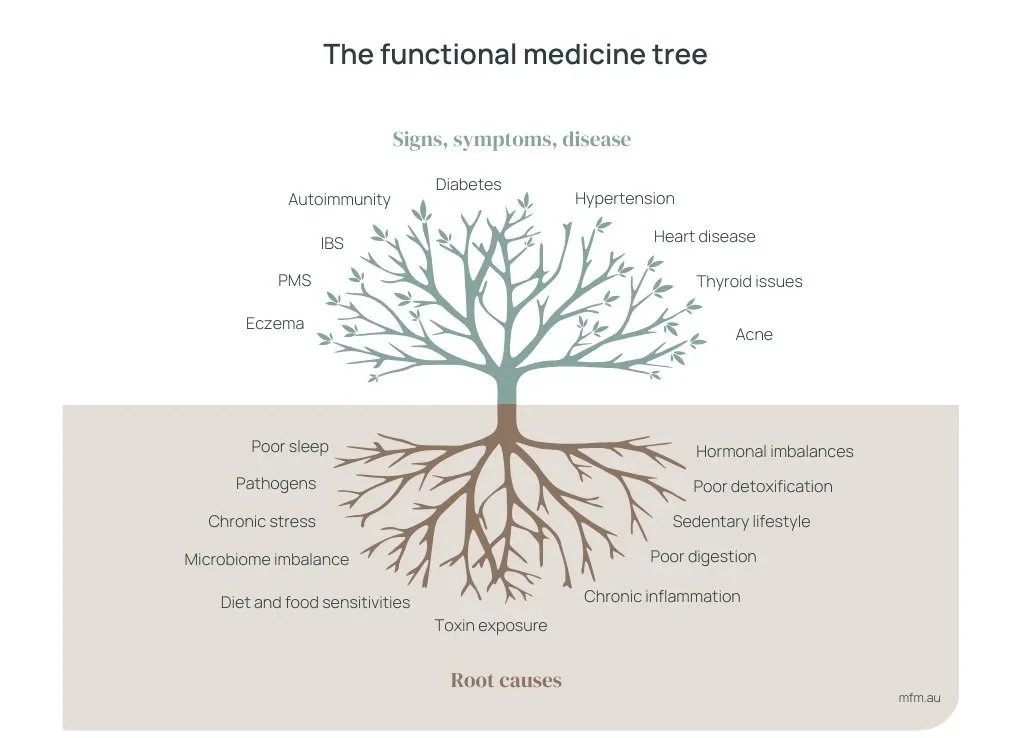
It considers the body as an interconnected system and explores how different aspects of your health and everyday life may influence one another. These can include your health history, genetics, nutrition, digestion, sleep, stress, movement, medications, environment and daily habits.
Rather than viewing every symptom as a completely separate problem, functional medicine looks for patterns within the wider picture. It asks questions such as:
When did your concerns begin?
What was happening in your health or life at that time?
Which factors may be contributing to how you feel now?
Are there realistic changes that could support your health?
This does not mean that every symptom has one hidden “root cause”, or that nutrition and lifestyle can solve every health problem. It means taking the time to understand the individual, consider possible contributing factors and identify the areas that may be relevant and possible to change.
Where Did Functional Medicine Come From?
The modern functional medicine model developed in the United States during the early 1990s through the work of the Institute for Functional Medicine. It brought together ideas from nutritional science, lifestyle medicine, systems biology and personalised healthcare.
Systems biology recognises that the body is made up of interconnected systems rather than isolated parts. Functional medicine applies this idea to healthcare by considering how physical health, nutrition, lifestyle, environment and personal history may interact.
It is particularly suited to situations where health concerns are complex, longstanding or influenced by several factors rather than one simple explanation.
In 2014, the Institute for Functional Medicine collaborated with Cleveland Clinic to establish a functional medicine programme within a major academic medical centre. The model continues to develop through clinical practice, education and ongoing research.
The Main Principles of Functional Medicine
It is personalised
Two people may experience similar symptoms but have very different health histories, lifestyles and nutritional needs. Functional medicine therefore focuses on the individual rather than relying on a standard protocol.
It considers the wider picture
Symptoms are important, but they are considered alongside factors such as sleep, stress, eating patterns, medications, movement, nutrient intake, medical history and everyday routines.
It looks for connections
Functional medicine explores whether different concerns may share contributing factors or influence one another.
It focuses on modifiable factors
Some aspects of health cannot be changed. Others, such as eating patterns, sleep routines, movement, stress management and nutrient intake, may be open to practical support.
It is collaborative
You are involved in decisions about your health. Recommendations should reflect your priorities, preferences, circumstances and capacity for change.
How I Use Functional Medicine Principles
My work is best described as functional medicine-informed nutritional therapy.
I use functional medicine as a framework to organise information, ask broader questions and consider how different aspects of your health may be connected. It helps me look beyond an isolated symptom while still recognising the importance of appropriate medical diagnosis and care.
In my nutritional therapy practice, these principles help me consider:
your symptoms and health history
your medical and family history
your nutrition and eating patterns
your medications and supplements
your sleep, stress and energy levels
your movement and daily routines
previous diagnoses and test results
your practical circumstances and personal goals
I then use evidence-based nutritional therapy to turn the most relevant information into practical food and lifestyle recommendations.
My pharmacy background also gives me an additional safety perspective when reviewing medications, supplements and possible drug–nutrient interactions.
Functional testing may sometimes be discussed, but it is not automatically necessary. I only consider testing when it is likely to answer a useful question or influence the recommendations we make.
Working Alongside Medical Care
Functional medicine-informed nutritional therapy complements rather than replaces medical care.
I do not diagnose medical conditions or advise clients to stop prescribed medication. Where symptoms require medical assessment, investigation or treatment, I will recommend speaking with your GP or another appropriately qualified healthcare professional.
Where appropriate and with your permission, I can also communicate with your healthcare team so that your nutrition and lifestyle support sits safely alongside your existing care.
What This Means for You
A functional medicine-informed approach gives you the opportunity to step back and consider the wider context of your health.
It can help you:
understand how different aspects of your health may be connected
make sense of conflicting nutrition and wellness advice
identify clear and realistic priorities
receive recommendations personalised to your circumstances
become more informed and confident in your health choices
Functional medicine provides the framework. Nutritional therapy turns that framework into practical action.